
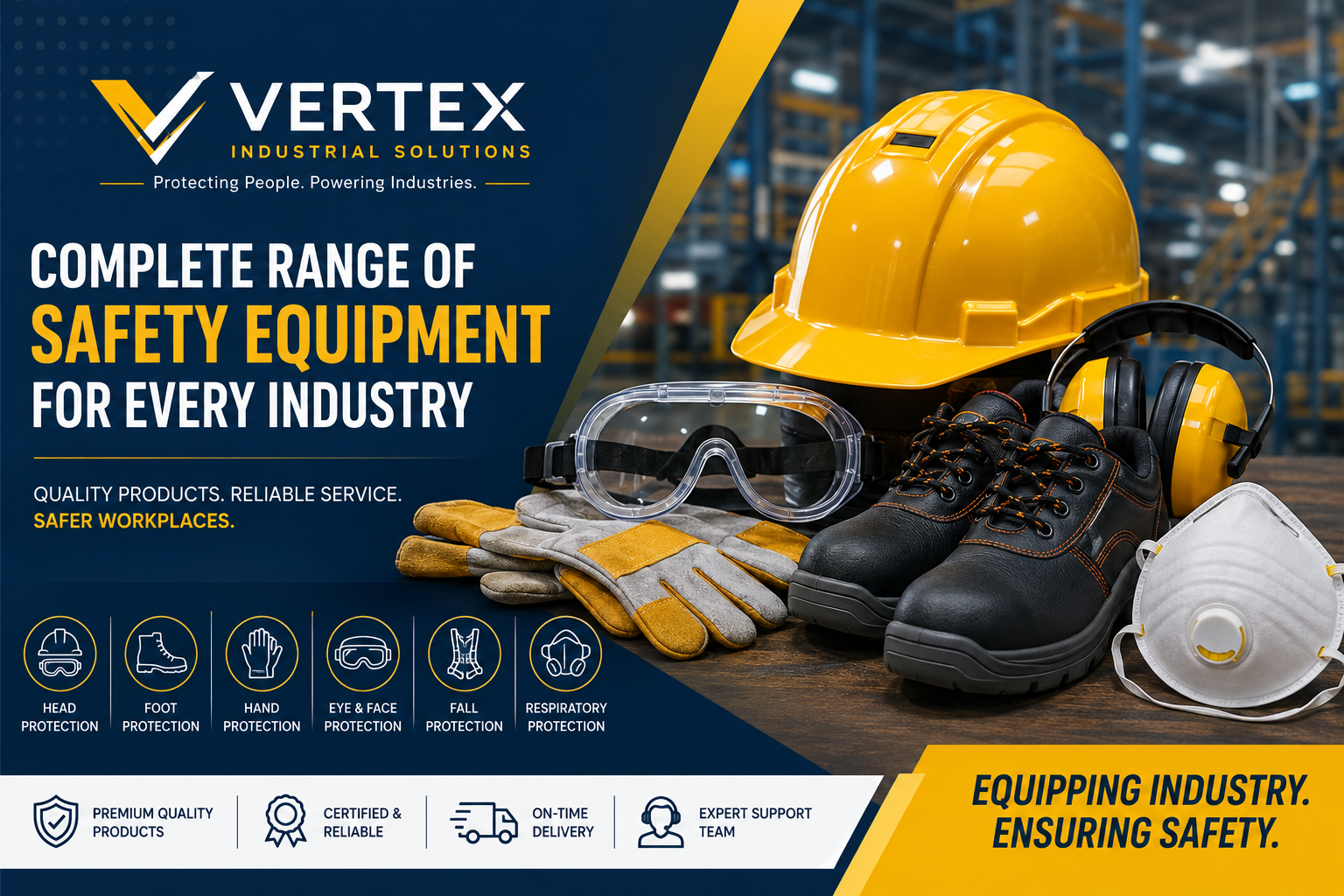
Workplace safety is one of the most important responsibilities of any industrial organization. Whether you operate a manufacturing plant, construction site, warehouse, pharmaceutical facility, food processing unit, steel plant, or engineering workshop, employees are regularly exposed to different workplace hazards.
Personal Protective Equipment (PPE) provides an essential layer of protection against these risks. From safety helmets and protective footwear to gloves, goggles, respirators, and full-body harnesses, the right PPE can significantly reduce the risk of workplace injuries.
At Vertex Industrial Solutions, we provide a comprehensive range of industrial safety products and PPE designed to help organizations create safer and more productive workplaces.
What is Personal Protective Equipment (PPE)?
Personal Protective Equipment, commonly known as PPE, refers to protective clothing and equipment worn by workers to reduce their exposure to workplace hazards.
Depending on the working environment, employees may face risks from falling objects, sharp materials, chemicals, dust, fumes, excessive noise, electrical hazards, heat, sparks, moving machinery, and working at heights.
PPE is designed to provide protection when exposure to such hazards cannot be sufficiently avoided through other safety measures.
It is important to remember that PPE should be part of a broader workplace safety system that includes hazard assessment, safe operating procedures, engineering controls, employee training, equipment maintenance, and emergency preparedness.
Why is PPE Important in Industrial Workplaces?
Industrial environments can present multiple hazards at the same time. A worker in a manufacturing plant, for example, may require protection for the head, eyes, hands, feet, hearing, and respiratory system.
Using appropriate PPE helps organizations protect employees and promote a stronger safety culture.
The right PPE can help reduce exposure to workplace hazards, minimize the severity of certain injuries, improve worker confidence, support organizational safety procedures, and reduce operational disruptions caused by accidents.
However, simply providing PPE is not enough. The equipment must be appropriate for the identified hazard, properly fitted, correctly worn, regularly inspected, maintained, and replaced when necessary.
Essential Types of Personal Protective Equipment
Different workplaces require different forms of protection. A proper workplace hazard assessment should therefore be carried out before selecting PPE.
Here are some of the most commonly used categories of industrial PPE.
1. Safety Helmets
Safety helmets are among the most recognizable forms of industrial protective equipment. They are designed to protect the head against hazards such as falling or flying objects and accidental impacts.
They are widely used in construction sites, manufacturing plants, warehouses, engineering facilities, power plants, steel plants, and maintenance operations.
The type of helmet selected should correspond to the hazards associated with the job.
2. Safety Shoes
Industrial workers often spend long hours in environments containing heavy equipment, sharp materials, slippery surfaces, and other foot hazards.
Appropriate safety footwear can provide protection against hazards such as impact, compression, punctures, slips, and certain electrical or chemical risks depending on its design.
Safety shoes should also provide adequate comfort and support, especially for employees who stand or walk for extended periods.
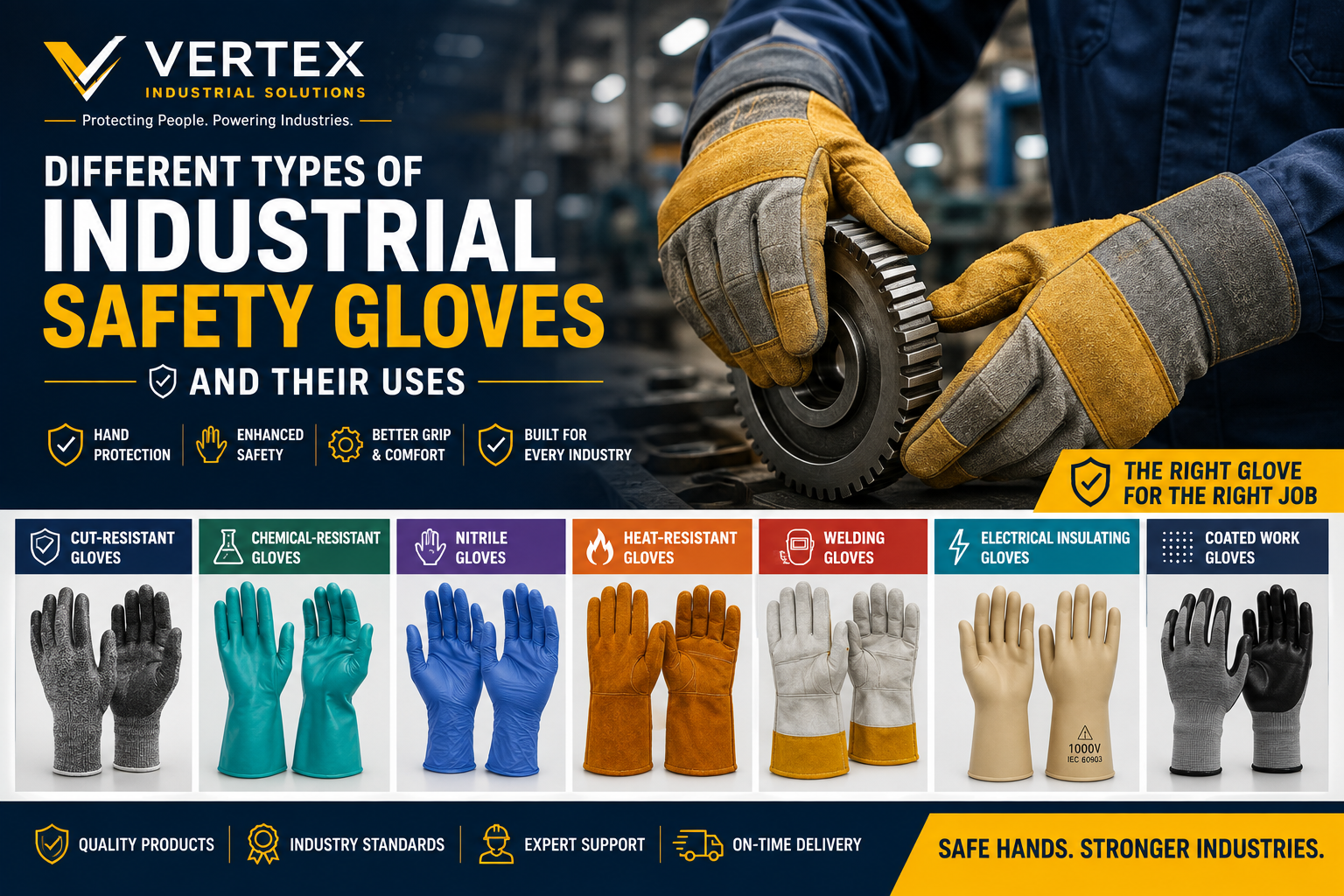
3. Industrial Safety Gloves
Hands are involved in almost every industrial activity, making appropriate hand protection extremely important.
Different gloves are designed for different hazards. Examples include cut-resistant gloves, chemical-resistant gloves, heat-resistant gloves, welding gloves, electrical insulating gloves where appropriate, and general-purpose handling gloves.
Employers should avoid selecting gloves solely based on price. The glove material and protection level should match the actual task and hazard.
4. Safety Goggles
Dust, chemicals, sparks, fragments and flying particles can pose serious risks to the eyes.
Safety goggles provide a protective barrier around the eyes and are commonly used during grinding, drilling, cutting, chemical handling, construction, maintenance, and manufacturing activities.
The correct type of eye protection should be selected according to the specific exposure.
5. Face Shields
Face shields provide additional protection for the face against certain splashes, sparks, flying particles, and other hazards.
Depending on the task and hazard assessment, a face shield may need to be used together with appropriate safety glasses or goggles rather than as a replacement for them.
6. Ear Plugs and Ear Muffs
Factories, construction sites, workshops, power plants, and heavy engineering facilities can expose workers to high noise levels.
Suitable hearing protection, including ear plugs and ear muffs, can help reduce harmful noise exposure when used as part of an effective hearing conservation program.
The appropriate level of protection should be selected based on workplace noise assessment.
7. Respirators and Dust Masks
Industrial workers may encounter dust, fumes, vapours, gases, aerosols, or other airborne contaminants.
Respiratory protection must be selected carefully according to the specific contaminant and exposure conditions. Different respirators are designed for different hazards, and not every mask is suitable for every industrial environment.
Where respiratory protection is required, organizations should ensure proper selection, fit, use, maintenance, and worker training.
8. Reflective Safety Jackets
High-visibility jackets and vests make workers easier to see, particularly around vehicles, forklifts, heavy machinery, warehouses, loading areas, construction sites, and low-light working environments.
They are especially important in locations where workers and moving vehicles operate close to one another.
9. Full Body Safety Harnesses
Working at height presents potentially serious risks.
A full-body harness can form part of a properly designed fall-protection system for workers performing tasks at elevated locations. Harnesses may be used with suitable connectors, lanyards, lifelines, energy absorbers, and approved anchorage systems depending on the application.
Fall-protection equipment should be selected and used according to the specific work environment and applicable safety requirements.
How to Choose the Right PPE
There is no single set of PPE that is suitable for every workplace. Selection should begin with understanding the hazards associated with each job.
Organizations should consider the nature and severity of the hazard, duration and frequency of exposure, working environment, compatibility between different pieces of PPE, correct sizing and fit, worker comfort, applicable standards, manufacturer instructions, maintenance requirements, and replacement intervals.
PPE should also be easy enough to use correctly. Equipment that is uncomfortable or poorly fitted may discourage consistent use.
PPE Inspection and Maintenance
Purchasing quality PPE is only the beginning. Protective equipment should be regularly inspected to ensure that it remains in serviceable condition.
Helmets should be checked for cracks or damage. Safety glasses and goggles should be checked for damaged lenses or frames. Harnesses and lanyards require inspection for cuts, fraying, damaged stitching, deformation, or defective hardware. Gloves should be replaced when their protective integrity is compromised.
Reusable PPE should be cleaned and stored according to manufacturer recommendations.
Damaged or unsuitable equipment should not continue to be used simply because it still looks usable.
Industries That Require PPE
PPE is used across almost every industrial sector, although the required equipment varies according to workplace hazards.
At Vertex Industrial Solutions, we cater to requirements across manufacturing industries, aqua feed industries, food and beverage facilities, pharmaceutical industries, cement plants, steel and metal industries, power plants, construction companies, warehouses and logistics facilities, educational institutions, hospitals, engineering companies, and government organizations.
Building a Strong Workplace Safety Culture
Workplace safety cannot depend on PPE alone.
Businesses should combine appropriate PPE with effective hazard controls, documented safety procedures, employee training, equipment maintenance, workplace inspections, emergency planning, and management commitment.
Employees should understand not only how to wear PPE but also why it is required and what limitations it has.
When safety becomes part of everyday operations rather than simply a compliance activity, organizations can create safer and more productive workplaces.
Your Trusted Partner for Industrial PPE & Safety Equipment
Choosing dependable safety products is an important part of protecting employees and maintaining efficient industrial operations.
Vertex Industrial Solutions supplies a wide range of Personal Protective Equipment and industrial safety products, including safety helmets, safety shoes, industrial gloves, safety goggles, face shields, hearing protection, respirators, reflective jackets, full-body safety harnesses, and other workplace safety solutions.
We focus on quality products, competitive pricing, reliable sourcing, prompt service, and solutions suited to different industrial requirements.
Whether you need PPE for a manufacturing facility, construction project, warehouse, engineering unit, pharmaceutical facility, or other industrial operation, Vertex Industrial Solutions can support your procurement requirements.
Conclusion
Personal Protective Equipment plays a vital role in reducing workers’ exposure to workplace hazards. But effective protection depends on selecting the right equipment, using it correctly, inspecting it regularly, and combining it with a comprehensive workplace safety program.
Investing in suitable PPE is ultimately an investment in the people who keep your organization running.

1 Comment
Vel quod autem aut quisquam. qui minima ut sit et. Et amet pariatur provident omnis. Voluptas enim esse repellat qui id. Inventore quo molestias eum velit praesentium. dolor est qui quibusdam voluptatibus. Est tempore delectus. expedita dolor necessitatibus illum Odit quia quibusdam quia sapiente Reprehenderit quisquam animi suscipit libero voluptas alias omnis. aut voluptatem mollitia quam aut dolorem. Minima qui culpa sapiente. Quidem corporis dolore omnis sunt eum. Omnis similique laudantium saepe dolorum velit odit.